
S3 Collective is a 501(c)(3) nonprofit connecting scientific research and consensus standards to advance quality and safety in cannabis and other botanical products. In this recurring ATACH column, we examine available standards and the business decisions they can inform.
Cannabis businesses can draw on published ASTM specifications when deciding what a cannabis label says about a product and how its cannabinoid claims are supported. Companies can identify the applicable standards and editions in their label briefs alongside each market’s requirements. [1, 2, 5] Brands can also join ASTM Committee D37 to help shape standards through their consensus-based voting process.
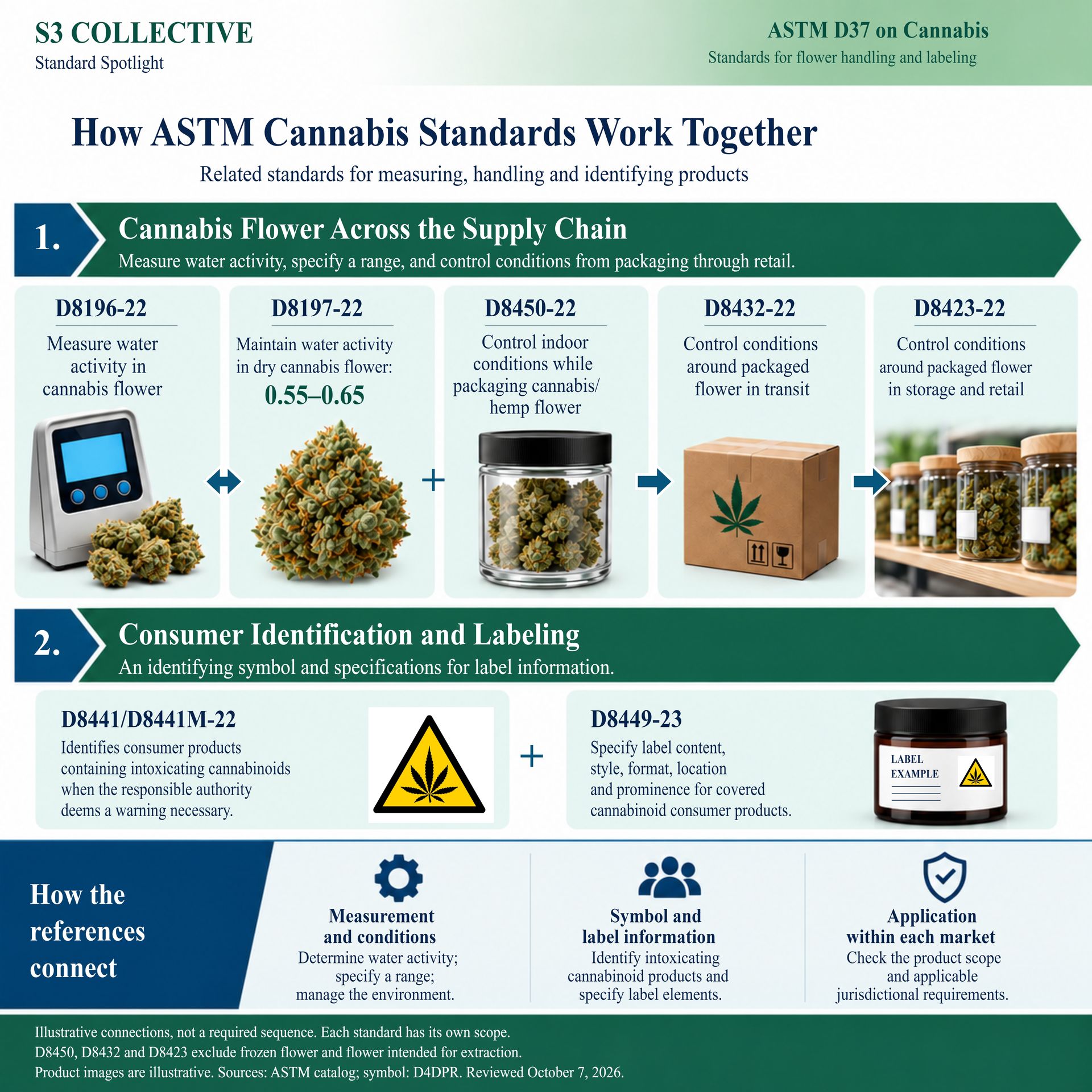
ASTM D8449-23 addresses label content and presentation for cannabinoid consumer products within its scope. It addresses cannabinoid-content declarations; verification of content, dominance and ratio claims; and the format, location and prominence of label elements. Companies making cannabinoid ratio claims can consult this specification when developing and substantiating those claims. [2, 5]
ASTM D8441/D8441M-22 addresses a different labeling element: the international symbol identifying consumer products containing intoxicating cannabinoids at levels for which the responsible authority requires a warning. Minnesota’s labeling rule provides an example of its use, specifying the D8441 symbol with “THC” beneath it. [1, 3]
Companies must also consider how the specification interacts with applicable regulations. D8449 specifies that the stricter provision takes precedence where its provisions and jurisdictional requirements differ; where they conflict, the authority having jurisdiction takes precedence. [2]
Consumer research can test how people interpret label information. In experiments conducted in 2017 and published in 2020, 870 Canadians aged 16–30 viewed different cannabis labels. On a task asking them to identify a recommended serving, 54.1% answered correctly when the label stated the number of doses per package, compared with 13.4% when it stated THC in milligrams. Although the experiments did not evaluate either ASTM standard, a forthcoming study will specifically assess the effectiveness of the D8441 symbol. [6]
S3 Collective has secured funding to commission a consumer study in collaboration with UNLV’s Cannabis Policy Institute and Doctors for Drug Policy Reform. A survey conducted through NORC at the University of Chicago will examine how consumers recognize and interpret the D8441 symbol as an identifier for products containing intoxicating cannabinoids. Initial findings are expected in the fourth quarter of 2026 and could inform future labeling practices and more consistent product identification. [4]
S3 Collective connects science to policy through research, support for consensus standards and education for businesses and regulators. The 2026 Global Cannabis Regulatory Summit White Paper, recently covered by Business of Cannabis, describes S3 Collective’s role in this work and includes a funding proposal. [7, 8] S3 Collective is also the exclusive cannabis 501(c)(3) organization participating in the FDA’s Network of Experts, which connects agency staff with external scientific and clinical expertise. [9]
We invite ATACH members to support this broader work by funding independent research and educational resources that help translate scientific findings into practical guidance on product quality, safety and labeling. Contact S3 Collective to discuss donations, board involvement or project funding.
Sources
- ASTM D8441/D8441M-22
Official catalog, active designation and scope. - ASTM D8449-23
Official catalog, active designation and scope; clauses 1.9 and 1.10 address jurisdictional requirements. - Minnesota Rule 9810.1400
Subpart 3A specifies the D8441 symbol with THC beneath it. - S3 Collective consumer study announcement
Release dated October 1, 2026, posted October 2. Funding, collaborators, study purpose and anticipated findings. - ASTM explanation of D8449
April 20, 2023. Explains cannabinoid declarations and verification of cannabinoid content, dominance and ratio claims. - Leos-Toro et al. 2020 consumer-label study
Cannabis labelling and consumer understanding of THC levels and serving sizes. Drug and Alcohol Dependence 208, 107843. DOI: 10.1016/j.drugalcdep.2020.107843. Experiments conducted in October 2017; final sample 870 Canadians aged 16–30. The 54.1% and 13.4% figures refer to the recommended-serving task. The study did not evaluate either ASTM standard. Full text - Global Cannabis Regulatory Summit White Paper 2026
Supplied white paper, printed pp. 12–13 and 88–91. S3’s research, standards-development support, education and funding proposal. - Business of Cannabis: GCRS white paper
September 30, 2026. Reports S3’s role in the standards initiative and the white paper’s funding proposals. - FDA Network of Experts program and participants
FDA lists S3 Collective as a participating partner.